
Logotip de Goodyear amb una bota amb una ala groga.

FAQ

The most suitable snow socks for your vehicle will differ according to the use they intend to make on ice and snow. Goodyear Snow Socks distinguishes between sporadic and intensive use. Sporadic is intended for drivers who occasionally use the snow socks due to ice and snow, a few times a year. Intensive or habitual is for those drivers who drive through snow and ice many times during the year so they will need a more resistant product.

Yes, grip increases considerably when using high quality snow socks. Goodyear Snow Socks can be fitted to both summer and winter tires (with or without studs).

Yes, Goodyear Snow Socks can be washed in the washing machine at max. 104°F. They should not be ironed or put in the dryer.

Yes, they are suitable for all types of front- and rear-wheel drive vehicles, 4X4, buses.

Yes, Goodyear Snow Socks can be used whether the vehicle has front, rear or 4X4 drive. 

In each package you will have 2 Goodyear Snow Socks, one for each wheel.

If you have an all-wheel drive 4X4 vehicle, two snow socks (1 package) will sigficantly improve traction. However, for even more stability, you may wish to purchase two packages for snow socks on all four vehicles to achieve optimum traction control in winter conditions.

  • Place the snow sock covering the top of the tire. Install the Goodyear Snow Socks with the vehicle parked on level ground (prohibited on slopes) and the handbrake applied. If your vehicle is equipped with an anti-skid system, do not disconnect it.
  • Stretch the fabric to cover the sides of the tire, starting with the inside wheel well.
  • Finish adjusting the tire sidewalls.
  • Move your vehicle forward so that the wheel makes a 1/2 turn and thus leaves the part of the tire not yet covered by the snow sock at the top.
  • Cover the upper area of ​​the tire with the snow sock.
  • Move slowly, after few miles the snow socks will adjust itself to your tire.
  • To watch how quickly and easily they can be installed – watch this video. 
  • Remove the snow sock from the top of the tire and its sides.
  • Back the vehicle to release the part covered by the snow sock so that the wheel goes back 1/2 turn.
  • Remove the snow sock and store it.
  • If your vehicle is equipped with an anti-skid system, do not disconnect it.
  • With the snow socks installed on your vehicle, you must start and drive carefully, avoiding acceleration, braking, sudden changes of direction, both for your safety and to preserve the life of the product.
  • If your snow socks have slight and local perforations after first use, they are still fully usable.
  • If the perforations exceed 50% of the tread width, the snow socks should be discarded and replaced.
  • Do not exceed 30 mph on snow or ice; it is advisable to reduce this speed. 
  • If you hear unusual noises, stop and check if the snow socks are properly fitted.
  • It is not recommended to use the snow socks on dry ground. Prolonged use without snow will cause damage to the product and may alter the vehicle’s reactions.
  • Snow socks should only be installed on tire sizes that match the size chart on this site. Please check your tire size before purchase to ensure you are choosing the correct size snow sock.
  • The snow socks should only be installed on snowy or icy ground. They should be removed when the road conditions do not justify their use or while the vehicle is parked.
  • It is not necessary to re-tension the snow socks after a short period of use.
  • When starting the vehicle, make sure that no one is behind the wheels of the vehicle as it could be damaged by flying stones, glass or other objects.
  • Even with the improved traction of snow socks, always drive with caution and be aware of your surroundings. 

Yes, Goodyear Snow Socks is a textile product that does not damage your tires.

Goodyear Snow Socks have all certifications for the United States, comply with CE standards and are certified, among others, by the ONORM 5121 standard. They are washable and reusable. It is certified by TUV, Onorm 5121 and corresponds to legislation B26. It is a patent-pending product. 

Where to Find Your Tire Size

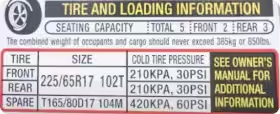
There are two places to find your tire size. Look directly on your tire sidewall or inside your driver’s side door jamb for your vehicle’s tire size.

Imagen de un neumático con las especificaciones de tamaño "215/60R16" resaltadas.
Passenger Tire Sidewall
Imagen de un neumático con las especificaciones de tamaño "35x12.5R17" resaltadas.
High Flotation Tire Sidewall
Etiqueta de información sobre neumáticos y carga para un vehículo.
Inside Your Door Jamb